Building the Path
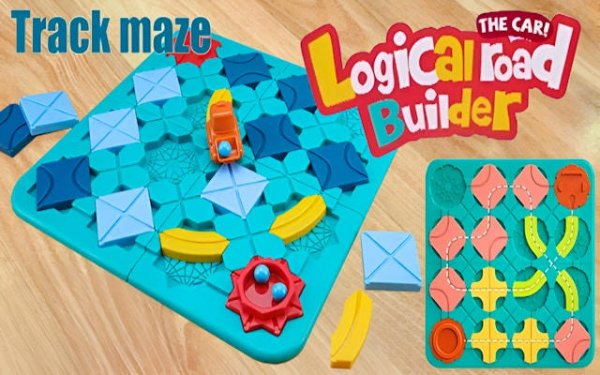
Each level presents a set of rectangular sliding pieces, every piece cut with a groove that forms part of a road. The player slides these pieces onto the board and arranges them so the grooves line up into one unbroken track. The track must run from a starting point to an endpoint. Once the layout is complete, a car travels the route carrying a ball. If the ball reaches its target, the puzzle is solved and the next level opens. The rules are simple enough for young children to grasp without reading long instructions.
What the Puzzles Ask of Players
The challenge is not speed or reflexes but planning. Players must look at the available pieces and work out which order and orientation will produce a smooth path. Early puzzles use few pieces and obvious connections. Later ones demand more careful spatial thinking, since a single misplaced piece breaks the route. This is where the game develops logical reasoning: children learn to test an arrangement mentally before committing, and to adjust when a groove does not meet its neighbour.
Bell and the Playful Setting
A friendly character named Bell guides the experience. The tone stays relaxed and constructive, with no time pressure and no penalty for a wrong arrangement. The game is designed as a safe digital space for children, with no advertisements or inappropriate content. That focus on a calm, positive environment matters for parents choosing screen activities.
Playing Together
Because a puzzle can be discussed rather than raced, children can work on levels alongside friends or family. One person might spot where a piece belongs while another checks the start and end points. This collaborative approach gives the game a social dimension beyond solo play, and it lets an adult or older sibling offer hints without taking over. The difficulty curve is gradual, so shared sessions stay engaging for mixed ages.








Comments
0 comments