The Core Mechanic
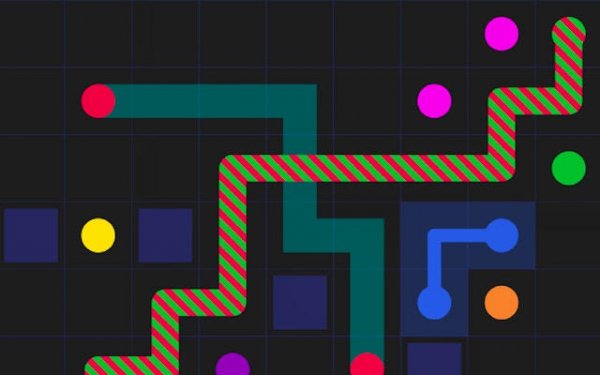
Each puzzle presents a grid populated with pairs of matching colored nodes. Your task is to draw a continuous path linking each pair. Two rules govern every solution: paths cannot cross or overlap, and every empty cell on the board must eventually be covered by a path. Those constraints turn a simple connect-the-dots idea into a spatial reasoning exercise where each connection reshapes the available space for the rest.
Progression and Difficulty
The game offers a substantial collection of puzzles arranged in a sequence. Early grids are small and use few colors, giving newcomers room to internalize the rules. Later puzzles expand the grid and pack in more color pairs, demanding careful sequencing and forward planning. The curve is gentle enough for casual players but still provides genuinely tough boards for experienced solvers.
Controls and Feedback
Interaction is straightforward. On touchscreens, drag a finger from one dot to its partner; the path snaps to the grid. With a mouse, click and drag in the same way. The game highlights valid paths as you draw and clearly marks completed connections. An undo button reverses your last move without penalty, so you can experiment freely and recover from mistakes.
Visual Style and Atmosphere
The aesthetic is deliberately clean. Bright, distinct colors separate the dots and their paths, while subtle grid lines keep attention on the puzzle. This minimalist approach reduces visual noise and supports the calm, focused feel that suits both short sessions and longer solving runs.
Strategic Thinking
Success depends less on speed and more on foresight. Before drawing, scan the board for bottlenecks—cells that only one path can occupy. The order in which you connect pairs often determines whether a solution exists at all. Patience and the ability to visualize multiple steps ahead are rewarded more than quick reflexes.







Comments
0 comments