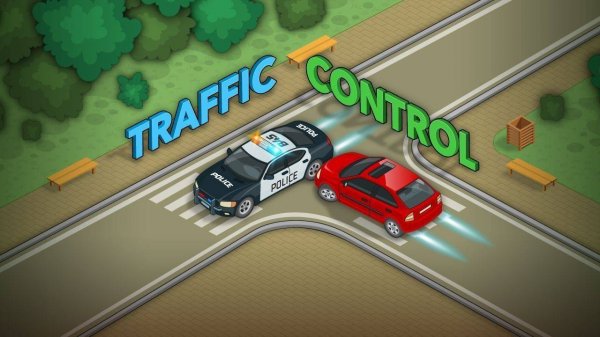
Reading the Junction
Every level in Traffic Logic: Intersection Control hands you a road layout and a set of cars, each following a colored route toward a designated exit. Your job is not to drive but to govern: you decide when a lane moves and when it waits. The puzzle is solved only when every vehicle clears the intersection without conflict, so the real task is understanding how several paths overlap before you touch a single signal.
Signals, Stop Signs, and Feedback
Interaction stays deliberately simple. Tapping a traffic light flips it between red and green, releasing the cars on that lane. Temporary stop signs can be placed at specific points to fine-tune movement when a light alone is not enough. Each action produces immediate visual feedback, so you can see the consequence of a mistimed switch. A collision resets the level, which turns failure into information rather than punishment.
From Crossings to Roundabouts
Early puzzles use two-way crossings where the correct sequence is easy to read. Later layouts introduce roundabouts, where cars enter and exit on a shared loop, and multi-lane merges that require sequencing vehicles arriving from different directions. Car counts rise and paths intertwine more tightly, so the same basic controls demand longer chains of planning. New road elements appear steadily enough that each stage tests a slightly different kind of reasoning.
Planning Without a Clock
There is no time pressure. You can study a junction, predict how the routes intersect, and commit to a sequence at your own pace. That design rewards careful analysis over reflex, and the difficulty comes from the complexity of the layout rather than from speed. Players who enjoy deduction, sequencing, and calm trial-and-error tend to get the most from it.








Comments
0 comments