Spinning the World to Move the Team
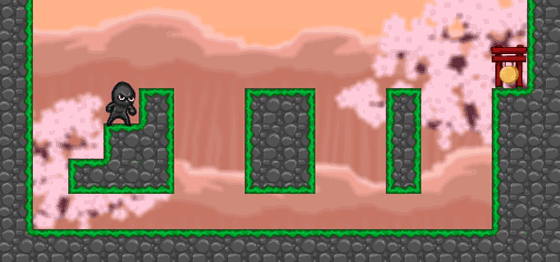
Temple Tile Turn Puzzle is built on one idea: the level itself is the control. A click or tap rotates the environment, and the ninja team travels along whatever surfaces are exposed by that rotation. The black ninja must reach the gong at the end of each stage, but the route is never fixed. Flipping the world can open a path or seal one off, so every rotation is a decision with immediate consequences.
Puzzle Layouts and Difficulty Curve
Each stage presents its own arrangement of platforms and obstacles. Early puzzles introduce the rotation controls with simple layouts, letting players build confidence before the game asks for more. Later puzzles require multiple rotations in a specific order, rewarding players who plan several moves ahead. The difficulty rises steadily rather than sharply, so the challenge stays present without becoming punishing.
Timing Alongside Logic
Because the ninja team moves continuously as surfaces turn, timing matters as much as logic. A rotation that would work in theory can still fail if it is triggered at the wrong moment, sending a ninja into a gap. Players balance when to flip the world with which direction to flip it, and that combination makes each solved puzzle feel earned.
Visual Clarity and Family-Friendly Design
The cartoon art style keeps platforms, obstacles, and the gong easy to tell apart, which matters when precise observation decides success. Bright, varied temple backgrounds keep stages visually distinct without cluttering the play area. Controls need only a single tap or click, and there is no fast-reflex requirement, so younger players and those who prefer a relaxed pace can enjoy it. The content stays family-safe, and the puzzles offer enough depth to hold an adult's attention across short or long sessions.










Comments
0 comments