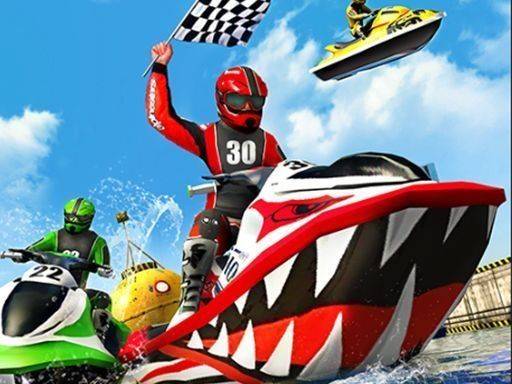
Track Design and Environment
Watercraft Racing Challenge spreads its races across three distinct environments: forest, desert, and icy landscapes. Each theme changes how you approach the course. Forest routes tend to have tighter turns that demand early braking and precise steering. Desert tracks offer longer straight sections where speed boosts pay off most. Icy surfaces require gentler handling, since sudden inputs can cost you control. The visual variety keeps each race from feeling like a repeat of the last, and it forces you to adjust your driving style rather than rely on one set of habits.
Racing Mechanics and Controls
You begin by choosing a watercraft and a track. From there, the controls are straightforward: accelerate, steer left or right, and trigger speed boosts. The challenge comes from reading the water ahead. Buoys and rocks act as obstacles, and checkpoints keep you on the intended route. Timing matters more than raw speed. Hitting a boost on a straight section gives you a clean advantage, while using one mid-turn can throw off your line. The water physics add weight to every movement, so acceleration and cornering feel connected rather than floaty.
Difficulty and Progression
Track difficulty increases as you move through the game, and the AI opponents are designed to adapt to your skill level. That means the competition stays relevant whether you are learning the basics or chasing faster lap times. Position and lap time feedback appears clearly, so you always know where you stand. There are no in-app purchases or disruptive ads, which keeps the focus on racing rather than interruptions. The game is built for short sessions as well as longer play, and it avoids violence or inappropriate content entirely.
Approaches That Work
Smooth turns preserve speed better than sharp corrections, so it helps to look ahead and begin steering early. Save boosts for straight sections where you can hold a clean line. On icy tracks, reduce sudden movements and let the watercraft settle before accelerating hard. Practicing on easier tracks first builds the reflexes you need for tighter forest routes and faster desert layouts. Watching your position and lap times gives you a clear measure of whether your adjustments are working.







Comments
0 comments