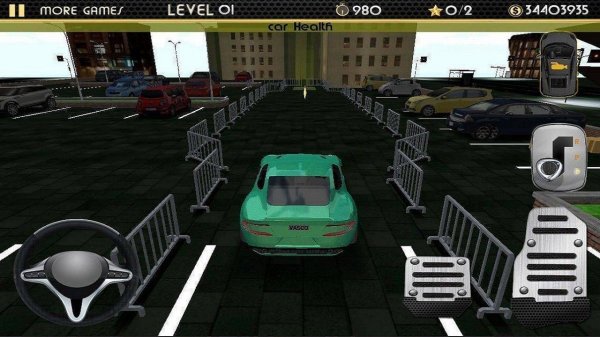
Core Parking Challenge
Night Parking Precision Driving Game puts players behind the wheel for one specific task: slotting a car into a parking space after dark. The difficulty comes from two sources working together. First, the parking spaces are tight, so small steering errors compound quickly. Second, the night setting limits how much of the surrounding street and obstacles you can see, which means you cannot simply eyeball a gap and commit. Instead, you have to judge distance and angle from the information available, then adjust in small increments. The game treats precision as the goal, not speed, so there is no reward for rushing a maneuver. A clean park is the whole point.
Reading the Indicators
Because visibility is reduced, on-screen indicators become a primary tool rather than a decorative overlay. They help you gauge how far the car is from the target space and at what angle you are approaching it. Using them well is the difference between a smooth adjustment and a correction that overshoots. The practical approach is to move gradually, watch how the car responds, and make small steering inputs rather than large ones. This is a game about feedback loops: you adjust, check the indicator, adjust again. Players who treat the indicators as a guide rather than a crutch will find the parking scenarios more manageable.
Scenario Variety
The game includes different parking situations, with parallel parking and reverse maneuvers among the featured challenges. Each scenario changes what you need to do with the wheel and how you read the space around the car. A parallel park asks for a different sequence of movements than backing into a spot, and the reduced night visibility makes those differences more pronounced. The variety keeps the core task from becoming a single repeated motion, and it gives players a reason to refine technique rather than memorize one approach.
Controls and Accessibility
Controls are designed to be smooth and responsive, and the game supports both keyboard and touch input. That flexibility matters because parking simulations live or die on how directly your input translates to the car's movement. The game is pitched as accessible for beginners while still offering enough complexity for experienced drivers, which suggests the early scenarios teach the basics before later ones demand finer control. Practicing regularly, repeating difficult levels, and focusing on gradual turns rather than quick movements are the most direct ways to build the spatial awareness the game rewards.





Comments
0 comments